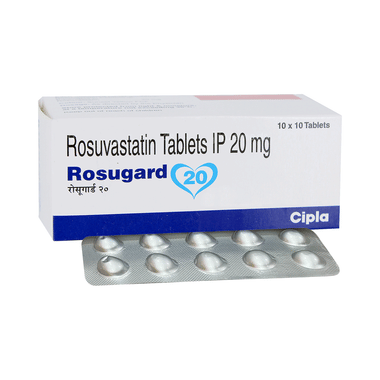

Rosuvid 20mg Tablet
 Prescription Required

Product introduction
Rosuvid 20mg Tablet can be taken with a meal or on an empty stomach. You can take it at any time of the day, but try to take it at the same time each day. Most people with high cholesterol do not feel ill. Do not stop taking the medicine suddenly without your doctor’s advice. Stopping your medicine may increase your cholesterol levels, making your condition worse and increasing your risk of heart disease and stroke.
This medicine is only one part of the treatment program, which should also include a healthy diet, regular exercise, smoking cessation, moderation of alcohol intake, and weight reduction. You can eat normally while taking this medicine, but try to avoid foods that are high in fat. It is important to have your cholesterol levels checked regularly.
Common side effects of this medicine include muscle pain, weakness, nausea, headache, and abdominal pain. These are usually mild and disappear after a short time. Consult your doctor if they persist or if you notice any yellowing of your eyes or get repeated or unexplained muscle pains.
This medicine should not be used in conditions such as liver disease. Also, pregnant women and breastfeeding women should not take this medicine, as it may harm the developing baby. Diabetic patients should monitor their blood sugar levels while taking this medicine, as it may lead to an increase in blood sugar levels.
Uses of Rosuvid Tablet
- Treatment of High cholesterol
- Treatment of High triglycerides
- Prevention of heart attack and stroke
Benefits of Rosuvid Tablet
In Treatment of High cholesterol
In Treatment of High triglycerides
In Prevention of heart attack and stroke
Side effects of Rosuvid Tablet
Common side effects of Rosuvid
- Muscle pain
- Nausea
- Weakness
- Headache
- Abdominal pain
- Dizziness
- Joint pain
How to use Rosuvid Tablet
How Rosuvid Tablet works
Safety advice
Use of Rosuvid 20mg Tablet is not recommended in patients with severe kidney disease.
Use of Rosuvid 20mg Tablet is not recommended in patients with severe liver disease and active liver disease.
What if you forget to take Rosuvid Tablet?
All substitutes
Quick tips
- Rosuvid 20mg Tablet is generally safe and well-tolerated; however, it may cause diarrhea, gas, or an upset stomach in some people. If any of these happen to you, take it with food.
- Inform your doctor if you experience fatigue, muscle weakness, or muscle pain.
- Your doctor may check your liver function before starting the treatment and regularly thereafter. Inform your doctor if you notice signs of liver problems, such as stomach pains, unusually dark urine, or yellowing of skin or eyes.
- Inform your doctor if you have kidney disease, liver disease, or diabetes before starting treatment with this medicine. If you are diabetic, monitor your blood sugar level regularly, as Rosuvid 20mg Tablet may cause an increase in your blood sugar level.
- Do not take Rosuvid 20mg Tablet if you are pregnant, planning a pregnancy, or breastfeeding.
Fact Box
Interaction with drugs
Patient concerns
FAQs
For how long should I take Rosuvid 20mg Tablet?
Does Rosuvid 20mg Tablet cause weight gain?
Does Rosuvid 20mg Tablet make you tired?
Should Rosuvid 20mg Tablet be taken at night?
What foods should be avoided when taking Rosuvid 20mg Tablet?
How do I know whether Rosuvid 20mg Tablet is beneficial for me or not?
Can Rosuvid 20mg Tablet cause memory loss?
Can Rosuvid 20mg Tablet cause muscle problems or muscle injury?
Is it true that Rosuvid 20mg Tablet can cause diabetes?
Related ayurvedic ingredients


Want to share the information?


Disclaimer:
Tata 1mg's sole intention is to ensure that its consumers get information that is expert-reviewed, accurate and trustworthy. However, the information contained herein should NOT be used as a substitute for the advice of a qualified physician. The information provided here is for informational purposes only. This may not cover everything about particular health conditions, lab tests, medicines, all possible side effects, drug interactions, warnings, alerts, etc. Please consult your doctor and discuss all your queries related to any disease or medicine. We intend to support, not replace, the doctor-patient relationship.References
- Bersot TP. Drug Therapy for Hypercholesterolemia and Dyslipidemia. In: Brunton LL, Chabner BA, Knollmann BC, editors. Goodman & Gilman’s: The Pharmacological Basis of Therapeutics. 12th ed. New York, New York: McGraw-Hill Medical; 2011. pp. 893-902.
- Gotto AM Jr, Opie LH. Lipid-Modifying Antiatherosclerotic Drugs. In: Opie LH, Gersh BJ, editors. Drugs for the Heart. 8th ed. Philadelphia, Pennsylvania: Elsevier Saunders; 2013. pp. 420-22.
- Briggs GG, Freeman RK, editors. A Reference Guide to Fetal and Neonatal Risk: Drugs in Pregnancy and Lactation. 10th ed. Philadelphia, PA: Wolters Kluwer Health; 2015. pp. 1238-39.
- Rosuvastatin calcium. Carolina, Puerto Rico: IPR Pharmaceuticals, Inc.; 2003. [Accecssed 20 Mar. 2019] (online) Available from:

- Drugs and Lactation Database (LactMed) [Internet]. Bethesda (MD): National Library of Medicine (US); 2006. Rosuvastatin. [Updated 2019 Jun 3]. [Accessed 19 Feb. 2020] (online) Available from:
- Central Drugs Standard Control Organisation (CDSCO). Rosuvastatin. [Accessed 19 Mar. 2019] (online) Available from:
- CiplaMed: Rosuvastatin calcium [Prescribing Information] (Accessed 27 Mar. 2025) (online) Available from:
Marketer details
Lab tests offered by us