








Slinda Tablet
Drospirenone (4mg)
 Genuine
Authenticity Assured
 Prescription
required
Product Summary :
Slinda Tablet contains drospirenone, a progestogen oral contraceptive used to prevent pregnancy. It works by suppressing ovulation and is taken once daily. Common side effects include acne, irregular vaginal bleeding, headache, breast pain, weight gain, menstrual cramps, nausea, and reduced sexual desire. It may increase potassium levels in the blood, particularly in women with kidney, liver, or adrenal disorders.Written By Dr. Syeda Aafia, MBA, BDS,
Reviewed By Dr. Mekhala Chandra, MD, MBBS,
Last updated on 15 Nov 2026 | 04:16 PM (IST)
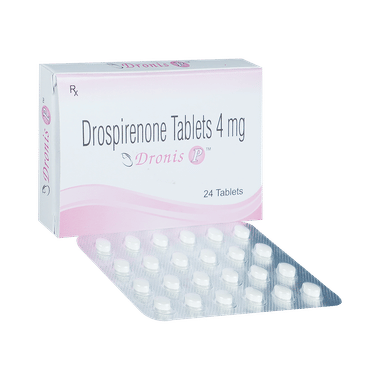
Available alternative from Sun Pharmaceuticals
Sold out

Slinda Tablet
strip of 28 tablets
₹440

Same composition
Dronis P Tablet
strip of 24 tablets
by Sun Pharmaceutical Industries Ltd
Get in 30 mins

₹442
₹15.67 per tablet
₹376
order for
₹1200
Save more with additional offers

Flat ₹50 cashback. T&C Apply*
Flat ₹50 cashback. T&C Apply*


Get upto Rs.150 Cashback on minimum transaction of Rs.599/- with Mobikwik UPI (@ikwik).
Get upto Rs.150 Cashback on minimum transaction of Rs.599/- with Mobikwik UPI (@ikwik).

Get up to ₹150 cashback on a minimum order value (MOV) of ₹499 and above, valid once per customer.
Get up to ₹150 cashback on a minimum order value (MOV) of ₹499 and above, valid once per customer.
Flat ₹50 cashback. T&C Apply*
Flat ₹50 cashback. T&C Apply*
Get upto Rs.150 Cashback on minimum transaction of Rs.599/- with Mobikwik UPI (@ikwik).
Get upto Rs.150 Cashback on minimum transaction of Rs.599/- with Mobikwik UPI (@ikwik).
Get up to ₹150 cashback on a minimum order value (MOV) of ₹499 and above, valid once per customer.
Get up to ₹150 cashback on a minimum order value (MOV) of ₹499 and above, valid once per customer.
Get up to ₹75 cashback on a minimum order value (MOV) of ₹499 and above, valid once per customer.
Get up to ₹75 cashback on a minimum order value (MOV) of ₹499 and above, valid once per customer.
General Information

The content is shown in English




All substitutes for Slinda Tablet
For information purposes only. Consult a doctor before taking any medicine.
Safety advice
Alcohol
CONSULT YOUR DOCTOR
It is not known whether it is safe to consume alcohol with Slinda Tablet. Please consult your doctor.

Pregnancy
SAFE IF PRESCRIBED
Slinda Tablet is generally considered safe to use during pregnancy. Animal studies do not indicate harmful effects. However, there are limited human studies.
However, discontinue taking Slinda Tablet if pregnancy occurs, as there is no reason to use hormonal contraceptives during pregnancy.
However, discontinue taking Slinda Tablet if pregnancy occurs, as there is no reason to use hormonal contraceptives during pregnancy.

Breast feeding
SAFE IF PRESCRIBED
Available human data suggest that the drug does not pass into breast milk in clinically significant amounts and is unlikely to harm the infant.

Driving
UNSAFE
Slinda Tablet may decrease alertness, affect your vision, or make you feel sleepy and dizzy. Do not drive if these symptoms occur.
Kidney
UNSAFE
Slinda Tablet is unsafe to use in patients with kidney disease and should be avoided.
Slinda Tablet is contraindicated in females with renal impairment.
Slinda Tablet is contraindicated in females with renal impairment.
Liver
UNSAFE
Slinda Tablet is unsafe to use in patients with liver disease and should be avoided.
This medicine is contraindicated in females with hepatic impairment.
This medicine is contraindicated in females with hepatic impairment.
References
- Drospirenone. Reading, Berkshire: Bayer Plc.; 2008 [revised 3 Dec. 2018]. [Accessed 04 Apr. 2019] (online) Available from:

- Central Drugs Standard Control Organisation (CDSCO). [Accessed 04 Apr. 2019] (online) Available from:
- Drospirenone. Florham Park, NJ: Exeltis USA, Inc.; 2025. [Accessed 19 Feb. 2026]. (online). Available from:
Related products
Products related to Slinda Tablet



100% genuine products

Safe & secure payments

No contact delivery

Fully sanitized facilities

Want to know more
We provide you with authentic, trustworthy and relevant information
Have issue with the content
Why we need a prescription?

